
Roof Moss in the Pacific Northwest: What Bellingham Homeowners Need to Know
David Bach
Owner, Spotless Heights ·
If you have lived in Bellingham more than a year, you have seen it — the creeping green that starts at the ridge of a north-facing rooftop and works its way down toward the eaves over the course of a wet season. It is so common in Whatcom County that many homeowners start to accept it as normal. It is not. Roof moss is an active threat to your shingles, your decking, and your warranty — and in Bellingham's climate, it grows faster than almost anywhere else in Washington State.
Here is what David Bach at Spotless Heights wants every Bellingham homeowner to understand about roof moss: what causes it, why it matters more than it looks, and how soft washing removes it without damaging the roof in the process.
Why Bellingham Roofs Get Moss So Fast
Moss does not need much to get started. It needs moisture, shade, and organic material to root into — and Bellingham delivers all three in abundance.
33 Inches of Annual Rainfall and Persistent Drizzle
Unlike the dry Seattle summer that can bake moss off southern exposures, Bellingham sees rain spread more evenly across the year. The drizzle that characterizes October through April keeps roof surfaces damp for days at a stretch. That persistent moisture is the primary accelerant for moss spore germination. A spore that lands on a shingle needs only a few weeks of consistent dampness to establish its first rhizoids — the root-like structures that grip the granule surface.
North-Facing Surfaces That Never Fully Dry
In Bellingham's latitude (roughly 48.75° N), north-facing roof planes receive very little direct sunlight from October through March. Morning dew and rain sit on north-facing shingles long after the south-facing side has dried. That extended dampness is why you will almost always see moss starting on north slopes first — and why those slopes can develop a heavy coverage in a single season if untreated.
Douglas Fir and Cedar Organic Debris
The towering Douglas firs, western red cedars, and big-leaf maples that make Bellingham beautiful also constantly shed organic debris — needles, seed scales, bark fragments, pollen. That material settles into the micro-texture of shingles and becomes the growth medium moss spores root into. A shingle that is kept swept clean by wind and rain on a sunny exposure might resist moss for a decade. The same shingle blanketed in fir-needle debris on a shaded north slope can show growth within one wet season.
Sudden Valley and Forested Neighborhoods
Homes in Sudden Valley sit in a forested hillside setting where canopy coverage is dense and sunlight reaches rooftops for only a few hours per day. Those conditions accelerate moss growth to a pace that surprises new residents. David services Sudden Valley homes regularly and sees roof moss cycling back within two years on the most heavily shaded properties. Birch Bay homeowners deal with elevated marine humidity that has a similar effect.
Why Moss Is More Than an Eyesore
A lot of homeowners look at roof moss and think of it as a cosmetic problem — something that makes the house look old and unkempt. It is actually a structural threat.
Moss Roots Penetrate Shingle Granules
Asphalt shingles rely on a layer of mineral granules for UV protection and weather resistance. Moss rhizoids physically work their way between those granules, loosening them from the asphalt mat beneath. Every year moss is allowed to grow, more granules are dislodged. You will see them in your gutters — dark, sand-like grit that looks like coffee grounds. Once granule loss becomes significant, the asphalt is exposed to UV degradation and the shingles become brittle, crack, and fail years ahead of their rated lifespan.
Moisture Retention and Wood Decking Rot
Moss holds water against the shingle surface like a sponge. On a roof with established moss coverage, the shingles beneath the moss layer stay damp even during dry spells. That persistent moisture works under shingles at laps and seams, reaching the wood decking beneath. Decking rot is expensive to repair — it requires removing shingles, replacing structural wood, and reinstalling roofing material. What started as a $400 moss treatment becomes a $3,000 decking repair if ignored long enough.
Warranty Implications
Most asphalt shingle manufacturers' warranties require that the roof be maintained and that biological growth not be allowed to damage the shingles. If a warranty claim is filed on a roof with documented heavy moss damage, the manufacturer's inspector will cite neglect and deny the claim. A Bellingham home whose owner skipped moss treatment for five years may find that a $15,000 roof replacement is entirely out-of-pocket despite having a "30-year warranty" shingle.
Weight Load When Saturated
A thick, mature moss layer on a 2,000-square-foot roof can hold a significant volume of water when saturated. While not typically a structural risk on modern framing, it adds unnecessary load and accelerates wear on the shingles beneath.
Soft Washing vs. Pressure Washing — Why the Method Matters
This is the question David gets asked most often by homeowners who have received multiple quotes: why does Spotless Heights use soft washing instead of just pressure-washing the moss off?
What High-Pressure Washing Does to a Roof
A standard pressure washer operating at 2,000–4,000 PSI physically blasts the surface of the shingle. On a concrete driveway, that force removes stains effectively with no lasting damage. On an asphalt shingle, the same pressure strips granules, forces water under shingle laps, and can lift the edges of individual shingles. It cleans the roof visually — but it accelerates the damage that moss was already causing and adds new damage of its own. Most roofing manufacturers explicitly void warranties if high-pressure washing is used.
The way David explains it to homeowners: pressure washing simulates decades of weather in a single pass. All the granule loss and surface wear a roof would normally accumulate over twenty-plus years of sun, rain, and freeze-thaw gets forced to happen in one afternoon. That single mental image is usually all it takes to understand why we will not do it — and why anyone who offers to "pressure wash your roof" is offering to age it prematurely.
How Soft Washing Works
Soft washing applies a low-pressure stream (under 100 PSI — roughly equivalent to a garden hose) of a diluted, biodegradable cleaning solution to the roof surface. The solution is formulated to kill moss, algae, lichen, and mildew at the biological level — it does not just blast them off the surface. After application, the moss gradually dies, turns yellow-white, and washes away naturally over the following weeks of rain. The root structures are killed rather than just cut off at the surface, which is why results last significantly longer than pressure washing.
The Spotless Heights Formula
The cleaning solution used by Spotless Heights is non-toxic, pet-safe, and plant-safe. It does not contain harsh bleach concentrations that kill landscaping or leave chemical residue that drains into your garden beds. David has a dog (Kenai, a regular companion on job sites) and applies the same standard he would to his own home — nothing goes on a roof that he would not be comfortable walking his dog past an hour later.
How Often Should You Treat Your Roof in Bellingham?
In Bellingham's climate, most homeowners need a soft-wash roof treatment every 2–4 years depending on these factors:
- Tree coverage: Homes with heavy conifer overhang may need treatment every 2 years. Open lots with minimal shade can often go 4 years between treatments.
- Roof orientation: North-facing slopes need more frequent attention than south-facing slopes that get daily sun exposure.
- Roof pitch: Steeper roofs shed debris and water more readily, which slows moss establishment. Low-slope roofs tend to hold standing water and debris longer.
Sodium Bicarbonate, Not Zinc Strips
You will see a lot of companies sell zinc strips along the ridge line. Spotless Heights does not install them, and recommends against them: zinc strips work by releasing zinc oxide every time it rains, and that runoff is especially damaging to the salmon-bearing waterways throughout Whatcom County. Suppressing moss is not worth poisoning the watershed to do it.
Instead, David offers a yearly sodium bicarbonate (baking soda) application as a preventative. It does essentially the same thing zinc does — raising the pH of the roof surface so moss has a much harder time germinating — but with no environmental downside. It is a supplement that slows regrowth and extends the time between full soft washes; it is not strong enough to treat established moss on its own, so it pairs with a soft wash rather than replacing one. David can advise on whether a yearly bicarbonate application makes sense for your roof during a quote visit.
Annual Inspection on North Slopes
Even with a full soft-wash treatment on the books, David recommends a visual inspection of north-facing slopes each spring. Early-stage regrowth spotted in year two can often be addressed with a spot treatment at a fraction of the cost of a full application.
The Before and After Difference
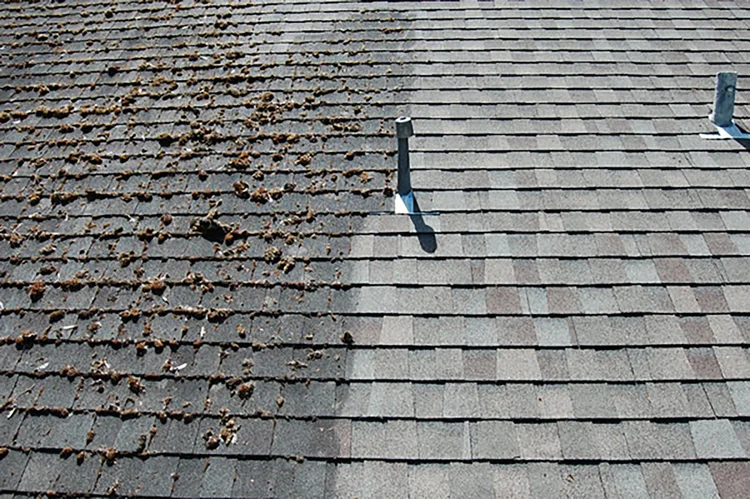
The before-and-after photos from Spotless Heights roof cleanings in Bellingham consistently show the same story: a roof that looked tired, green, and aged emerges looking years newer after treatment. The moss does not disappear overnight — soft washing is deliberately not the instant, surface-blasting result that pressure washing gives. Most homeowners see a noticeable improvement after the first significant rainfall, with the treated areas continuing to clear over the following months as the dead moss lifts and rinses away. Treating between October and March speeds this up, because our heavy rainfall does the rinsing work. Homeowners regularly tell David it looks like they got a new roof.
Chris T., a customer in the Barkley neighborhood, put it simply after his first soft-wash treatment: "A few weeks later the moss had turned white and washed away — roof looks brand new." That is the soft-wash result: biological kill that washes clean with normal rain, no power-washing abrasion, no warranty concerns.
Ready to protect your roof before the next moss season takes hold? Learn more about our Bellingham roof cleaning and moss removal service, or contact David for a free quote — he will assess your current moss coverage and recommend the right treatment schedule for your home.
Frequently Asked Questions
Is soft washing safe for asphalt shingles?
Yes — soft washing is actually the method recommended by most asphalt shingle manufacturers, including GAF and CertainTeed. It uses low pressure (under 100 PSI) combined with a biodegradable cleaning solution that kills moss at the root. High-pressure washing strips the protective granules from shingles, which accelerates wear and can void manufacturer warranties. Soft washing causes no physical abrasion and produces longer-lasting results.
How much does roof moss removal cost in Bellingham?
Roof moss removal and soft washing in Bellingham typically ranges from $299 to $900 depending on roof size, pitch, and the severity of moss coverage. Most single-story homes fall in the $299–$450 range. Spotless Heights provides free, no-obligation quotes — call or text (360) 999-1266.
How long do roof moss treatment results last in Bellingham?
In Bellingham's climate, a soft-wash moss treatment typically keeps moss from returning for 2–4 years depending on the level of conifer coverage, the roof pitch, and sun exposure. North-facing slopes with heavy tree coverage are on the shorter end of that range. Combining treatment with annual inspections and an optional yearly sodium bicarbonate (baking soda) application extends the time between full treatments — we use bicarbonate instead of zinc strips, whose zinc-oxide runoff harms local salmon waterways.
Ready to Protect Your Home?
Free quotes, same-day response. Serving Bellingham and all of Whatcom County.