Why We Use Oxygen Bleach, Not Chlorine
Nearly every company sprays chlorine bleach on your roof. We don't. Here is the honest difference between sodium hypochlorite and the eco-friendly sodium percarbonate we use exclusively.
Why We Use Oxygen Bleach, Not Chlorine
Most exterior cleaning companies in Whatcom County clean roofs, sidings, and driveways with the same chemical: sodium hypochlorite — household chlorine bleach, usually at industrial strength. Spotless Heights deliberately does not. We work exclusively with sodium percarbonate, commonly known as oxygen bleach. Both chemicals kill moss, algae, and lichen growing on your home, as well as prevent rapid regrowth, but the main difference between the two is what they leave behind. This page explains the difference honestly, so you understand exactly what is being sprayed and how we came to our decision to exclusively use sodium percarbonate.
How the Two Chemicals Actually Work
At a biological level, both chemicals kill organic growth the same way; a process known as oxidation. Once the chemicals contact moss, algae, and lichen they begin to strip away the chlorophyll and cell walls of the organism. Without its cellular structure these organisms begin to rapidly decay turning from a healthy green to a yellowish white. The critical difference is how aggressively they work.
Sodium hypochlorite (chlorine bleach) is a powerful, but highly toxic chemical compound. Its toxicity is what makes it so effective, relying on the release of corrosive compounds to quickly kill bacteria and organisms. But that same indiscriminate strength is the problem: it will kill your shrubs, your lawn, and can cause potential damage to nearly everything it drifts on to.
Sodium percarbonate (oxygen bleach) is a far gentler, safer, and non-toxic chemical. When mixed with water for the application of soft washing, it begins to rapidly foam turning into hydrogen peroxide. When applied to moss, algae, and lichens, this foaming action allows it to deeply penetrate the organism releasing oxygen molecules which start the oxidation process. Because oxygen bleach is not nearly as strong as chlorine, it can't penetrate the cell walls of other plants, but it is highly effective against moss, algae, and lichens which have much thinner, simpler cellular structures. This is why oxygen bleach is so effective at treating the growth on your roof, and home, without damaging your landscape.
Why Chlorine Is More Dangerous
The toxicity that makes chlorine bleach fast, also makes it hazardous. It is dangerous for the person applying it, and it is dangerous for everything downstream of your roof: landscaping, garden beds, lawns, and — when it runs off into storm drains — the salmon-bearing creeks and bays that define this region. When chlorine bleach enters our soil and waterways it can attach to organic material forming a compound known as organochlorines. These organochlorines are often highly toxic and can cause damage to our local flora and fauna. In addition, they can remain active for months, or even for up to a year.
Chlorine Also Shortens Your Roof’s Life
As well as the environmental impacts, chlorine bleach can negatively impact the overall lifespan of your roof. Chlorine bleach has been proven to accelerate granule loss on asphalt shingle roofs, remove protective coatings on metal roofs, seep through concrete tile roofs damaging the underlayment, and strip cedar shake shingles of their natural protectants. Regardless of your roof type, soft washing with oxygen bleach is simply a safer bet.
We did not want to build a business on a chemical we would not feel comfortable spraying near our own family, dog, and garden. So, we don't. Oxygen bleach lets us clean your home thoroughly without poisoning the place we all live.
The Honest Trade-Off: Results Take Longer
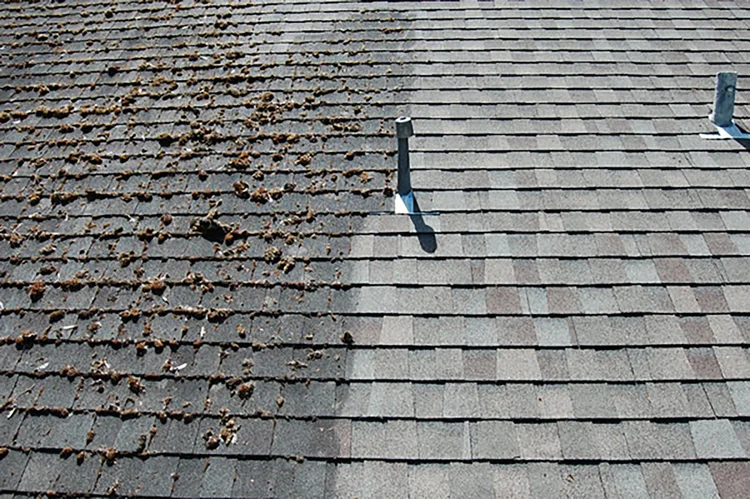
We will always be straight with you about the one downside of our approach: oxygen bleach works more slowly than chlorine. Because it lifts dead material to the surface gradually, you will not see a fully transformed roof the same day we leave.
What you can expect is a noticeable improvement after the first significant rainfall, with the final result developing over the following months as the dead growth continues to lift and rinse away. Treating between October and March speeds this up considerably, because our heavy rainfall, and strong winds do the rinsing work for you. It is a fair trade: a little patience in exchange for a roof that was cleaned without harsh, toxic chemicals — and without the granule loss and surface damage that aggressive methods cause.
See It in Action
This is the method behind our roof cleaning & soft washing, roof moss removal, and house soft washing. Learn more about roof moss in the Pacific Northwest.
Common Questions
Oxygen Bleach vs. Chlorine FAQ
What is the difference between sodium hypochlorite and sodium percarbonate?
Sodium hypochlorite is chlorine bleach — fast-acting and toxic enough to damage almost anything it contacts, which is why it harms landscaping and waterways. Sodium percarbonate is oxygen bleach — gentler and non-toxic; it oxidizes moss, algae, and lichen but is not strong enough to penetrate the tougher cell walls of your plants and lawn. We use sodium percarbonate exclusively.
If chlorine bleach works faster, why not use it?
Speed comes from toxicity. Chlorine bleach acts fast because it destroys virtually any organic material it touches, including your shrubs and lawn, and its runoff harms salmon-bearing waterways. We are not willing to trade environmental and landscaping damage for a faster-looking result, so we use eco-friendly oxygen bleach instead.
Does oxygen bleach actually kill the moss, or just clean the surface?
It kills it. Both chemicals work by oxidation — stripping the chlorophyll and cell walls of the moss, algae, and lichen so the organism decays. Oxygen bleach does this effectively on those simple organisms without being strong enough to harm the tougher plants around them, then the dead growth lifts to the surface and rinses away with the rain over time.
How long until my roof looks clean with your method?
Most homeowners notice a real improvement after the first significant rainfall, with the final result developing over several months as the dead growth rinses away. Scheduling between October and March gives the fastest results, since our heavy rainfall does the rinsing work.
Is oxygen bleach safe for my plants and pets?
Yes — that is the whole point of using it. It is not strong enough to penetrate the tougher cell walls of your plants and lawn, so it will not kill your landscaping the way chlorine bleach can. We also soak surrounding plants before and after every soft wash as an added precaution.
Cleaned the Right Way — No Harsh Chemicals
Don't Risk a Fall, Give Us a Call!
Serving Bellingham, Ferndale, Lynden, Blaine, Birch Bay, Sudden Valley, and all of Whatcom County. Same-day quote response.